GAP Insurance and Total Loss: How to Know If You’ll Still Owe Money
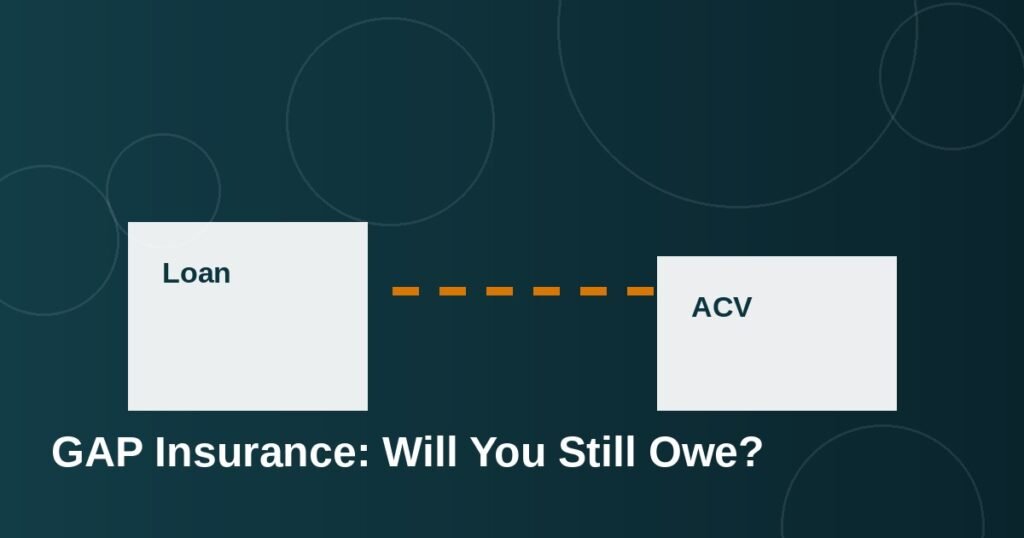
Totaling a financed car doesn’t total the loan along with it. That’s the part that catches people off guard, sometimes weeks after the accident itself has stopped feeling like the most stressful part of the situation: your insurer pays out the vehicle’s actual cash value (ACV), full stop — not whatever you still owe the bank. On a newer loan, or a lease, or really any financing arrangement with a small down payment or a longer term, those two numbers — what the car is worth and what you owe on it — can be thousands of dollars apart, and that gap doesn’t close itself just because the car is gone.
Why the gap forms in the first place, and why it’s bigger than people expect
New cars lose value fastest in their first year — commonly somewhere in the neighborhood of 20%, sometimes more depending on the model — and depreciation continues at a meaningful pace for the next several years after that. Loan balances, on the other hand, decline on a fixed amortization schedule that often doesn’t track that curve closely, especially early in the loan when a larger share of each payment is going toward interest rather than principal. A few factors make the gap noticeably worse: a small down payment, a loan term longer than five years, rolling over negative equity from a previous vehicle into the new loan, or financing at a higher interest rate. Any one of these can leave you owing meaningfully more than the car is worth for a year or two into an otherwise perfectly normal loan — and if a total loss happens during that window, that’s exactly when GAP coverage is supposed to step in.
Do the math yourself before assuming GAP has it handled
The shortfall is a straightforward calculation: your remaining loan or lease payoff, minus whatever your insurer’s ACV settlement actually pays out after your deductible is subtracted. It’s worth doing this calculation the moment you have your settlement figure, rather than waiting to see what GAP pays and being surprised either way. Our GAP Insurance Shortfall Calculator runs this exact math — enter your payoff balance, the insurer’s ACV offer, and your deductible, and it shows you the actual dollar figure you’re asking GAP coverage to close, rather than a vague sense that “there’s probably a gap.”
As a concrete example: say you owe $23,500 on your loan, your insurer’s total-loss settlement is $17,200, and your deductible is $500. Your insurer pays out $16,700 after the deductible, leaving a shortfall of $6,800. That’s the number a GAP policy is meant to cover — and it’s also the number worth double-checking against your specific GAP contract’s terms before assuming it’s simply handled.
Not all GAP coverage is the same product
“I have GAP insurance” can mean a few different things depending on where it came from, and the differences matter:
- Dealer-sold GAP is often technically a debt-cancellation agreement or waiver rather than an insurance policy in the strict sense, financed directly into your loan. Terms and exclusions vary significantly by dealer and by the finance company underwriting it.
- Insurer-sold GAP is typically added as an endorsement to your existing auto policy, usually the least expensive option, and often the most straightforward in terms of exclusions.
- Credit union or bank GAP is frequently offered as a lower-cost add-on when the loan itself is originated, sometimes with more favorable terms than dealer-sold coverage.
Because these come from different providers with different contract language, a blanket assumption like “GAP covers the difference between what I owe and what I get” can be technically true in outline but wrong in the specific dollar amount, once exclusions are applied.
The exclusions that actually catch people
Reading the exclusions section of a GAP contract is not most people’s idea of a productive afternoon, but it’s the difference between an accurate expectation and an unpleasant surprise. Common exclusions include:
- Past-due payments at the time of the loss — GAP typically covers the payoff gap, not payments you were already behind on.
- Extended warranties, service contracts, or other add-on products that were rolled into the original loan amount rather than paid separately.
- Unpaid interest and finance charges that had accrued but weren’t yet part of the scheduled payoff.
- Your insurance deductible — some GAP policies cover a portion of this (often capped around $500), many don’t cover it at all, and this is one of the most important lines to check specifically.
- A maximum payout cap or a maximum loan-to-value ratio that some GAP contracts include, which can leave a residual shortfall even with coverage in place if the original loan was unusually large relative to the vehicle’s value.
Filing the GAP claim itself
Once your auto insurance settlement is finalized, you’ll typically need to file a separate claim with the GAP provider — it doesn’t happen automatically just because your auto insurer paid out. You’ll generally need the auto insurance settlement documentation, your loan payoff statement, and sometimes the original GAP contract or certificate number. Timing matters here: most GAP providers set their own filing deadline, often somewhere between 30 and 90 days from the total-loss settlement, so this isn’t something to put off once you have the necessary paperwork in hand.
If there’s no GAP coverage at all
Without GAP, the shortfall is generally your responsibility to your lender directly — a separate obligation from your insurance settlement entirely, and one that doesn’t disappear just because the car itself is gone. The most useful thing to do here is contact your lender as soon as you know the settlement figure, rather than waiting for a bill to arrive. Many lenders will discuss a payment plan or a modified arrangement rather than expecting the full remaining balance in one payment, but that conversation goes better when you initiate it with the numbers in hand than when it starts with a collections notice.
The gap between “having GAP” and “being fully covered”
Not sure if you even have GAP coverage? Here’s where to actually check
It’s more common than you’d think to genuinely not remember whether GAP was purchased, especially if it was bundled into a dealer finance package years ago among a stack of other paperwork signed in a single sitting. Start with your loan or lease agreement itself — GAP, if dealer-financed, is usually listed as a line item in the itemized charges, sometimes labeled “debt cancellation coverage” or “GAP waiver” rather than “GAP insurance” outright. If you can’t locate the original paperwork, your lender’s customer service line can usually confirm whether a GAP product was financed into the loan, and if it was purchased through your auto insurer instead, it should show as a line item, however small, on your policy’s declarations page. It’s worth doing this check well before you ever need it — finding out during an active total-loss claim that you either do or don’t have coverage you weren’t sure about is a stressful way to learn.
Leased vehicles: GAP is often already built in, but not always
Most vehicle leases include GAP-equivalent coverage automatically as part of the lease agreement itself, since the leasing company — which technically owns the vehicle — has a direct financial interest in covering that payoff gap. This isn’t universal, though, and some leases explicitly exclude it or cap it in ways that mirror the same exclusions discussed above. If you’re leasing, it’s worth confirming this in writing rather than assuming it’s included just because most leases have it, particularly if you added any aftermarket modifications or extended the lease term beyond its original schedule, either of which can affect how a leasing company’s built-in gap coverage applies.
You generally can’t buy GAP coverage after a loss — timing is not flexible
This is worth stating plainly because it’s a common and costly misunderstanding: GAP coverage has to be in place before the total loss occurs. It’s not something you can purchase retroactively once you already know you’re upside down on a loan and have just been in an accident. Most GAP products can be added anytime during the life of an active loan, not just at the point of purchase, so if you’ve read this after realizing you don’t have it and your loan is still active, it’s worth getting a quote for standalone GAP coverage now, before anything happens, rather than waiting for a renewal cycle or assuming it’s too late to matter.
A second worked example, with GAP in place this time
Take a slightly different scenario: a $31,000 loan on a vehicle that’s two years into a six-year term, insurer’s ACV settlement of $22,400, a $1,000 deductible, and a GAP policy with a $50,000 maximum payout and no deductible-coverage provision. The insurer pays $21,400 after the deductible. The shortfall against the $31,000 payoff is $9,600. Because the GAP policy has no deductible-coverage clause, that $500 (already subtracted once as your auto insurance deductible) isn’t further reimbursed by GAP — GAP simply closes the $9,600 gap between payoff and settlement, in full, since it falls comfortably under the $50,000 cap. The driver in this scenario ends the process owing nothing further on the totaled vehicle — but only because the specific contract had no deductible exclusion. A different GAP contract, otherwise identical but excluding the deductible amount, would have left this driver with a $500 residual bill despite having “full” GAP coverage the whole time.
What happens to unused GAP premium if you pay off the loan early
If you paid for GAP coverage as a one-time charge financed into your loan and then pay that loan off early — through a refinance, a trade-in, or simply paying ahead of schedule — you may be entitled to a partial refund of the unused GAP premium, since the coverage is generally tied to the length of the loan it was protecting. This isn’t automatic in most cases; you typically have to request it directly from whoever sold the GAP product, and the refund calculation is usually prorated based on how much of the loan term remains. It’s a small detail, but it’s money that goes unclaimed fairly often simply because nobody thinks to ask after a loan closes out ahead of schedule.
Keep making loan payments until the payoff is actually confirmed
This trips people up more than it should: even after your auto insurer has agreed to a settlement and even after a GAP claim has been filed, your loan technically remains active — and your regular monthly payment technically still due — until the lender has actually received the payoff funds and formally closed the account. Skipping a payment because “the insurance is handling it” can result in a late payment reported to credit bureaus even though the loan is about to be paid off entirely, simply because the settlement and GAP processing hadn’t yet reached the lender when the payment was due. It’s a frustrating detail, but the safer approach is to keep payments current until you have written confirmation from the lender that the loan balance is zero, rather than assuming the various parts of the process are moving in sync.
Frequently overlooked: what shows up on your credit report after all this
A total loss and a properly processed GAP claim shouldn’t, on their own, show up as anything negative on your credit report — the loan simply gets marked as paid in full, closed, same as if you’d paid it off through any other means. Problems arise specifically when there’s a delay or a gap in the process — a late payment reported before the payoff posted, or a period where the shortfall was unresolved and the lender treated the account as delinquent while GAP and insurance were still sorting out the details. It’s worth pulling your credit report a couple of months after everything is settled just to confirm the loan shows as closed and current, rather than assuming it happened correctly in the background.
GAP insurance is a genuinely useful product, and for a lot of financed or leased vehicles it does exactly what it’s supposed to. But “I have GAP insurance” and “GAP insurance covers every dollar of this specific shortfall” are two different statements, and the difference between them lives in the exclusions section of a contract most people never fully read until they need to. Running the numbers yourself, and checking your specific contract’s terms before you count on it, is what turns a total loss from a financial surprise into a process you already understand the shape of.